
Scouting Skills Under Confinement
The RoomThis thread traces how the protagonist’s remembered scout training first offers proof of competence, then gives way to repetitive rituals that cannot restore control inside the cell.
increasing Bearing strength in each event
 decreasing
Bearing strength in each eventdecreasingThe Scout Troop
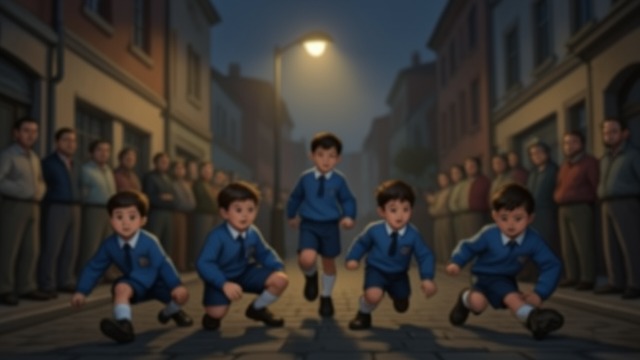
A Troop Remembered
Competence Recalled
The cell’s fixed sights send the unnamed prisoner back to his small Brooklyn scout troop. He remembers games with the other boys and the confidence of having been among the best at scouting skills.
The recollection briefly gives him a past in which effort produced recognizable achievement. Recalling that younger self contrasts with the present, where there is little to do and almost nothing he can change.
Knowledge Tested
He inventories what he still knows: directions, tracking, and the knots illustrated in a scout manual. Remembering these skills becomes a private exercise in preserving continuity with the person he was before confinement.
Boxing the Compass

A Memorized Compass
Directions Rehearsed
With his eyes closed, the prisoner recites the compass points in sequence, then reverses them to check himself. The orderly progression provides a task with a clear beginning and end, unlike the unmeasured hours surrounding him.
He takes satisfaction in realizing that he can still perform the exercise years after scouting. The memory turns knowledge into a small reserve of agency: even in the cell, he can summon a system and follow it correctly.
Repetition as Shelter
That achievement is temporary. The directions loop back to their starting point, echoing his broader sense that time and effort return him to the same place. The exercise comforts him without changing the conditions that make him need it.
The Knot List
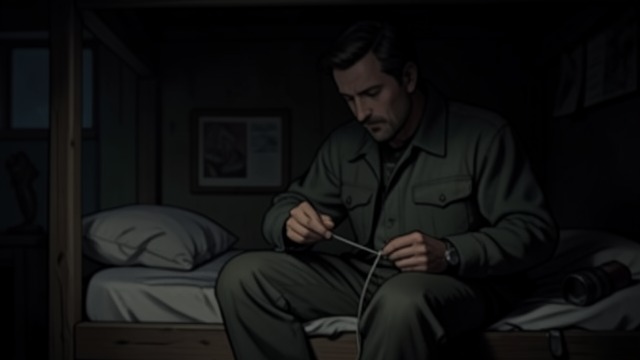
The Knots He Remembers
A Manual in Memory
He tries to reconstruct the knots from the scout manual, naming familiar examples and picturing their diagrams. At first the remembered lesson seems intact: he believes that, given a piece of string, he could still tie them.
The list brings back the practical, teachable side of childhood. Knots had once been skills learned through instruction and practice, not puzzles that demanded endless speculation.
A Small Assurance
He adds two hitches he nearly forgot and takes this as further proof that his memory has not failed him. For a moment, remembered knowledge steadies him against the cell’s sameness and his uncertainty about what remains of his former life.
The Counting Route
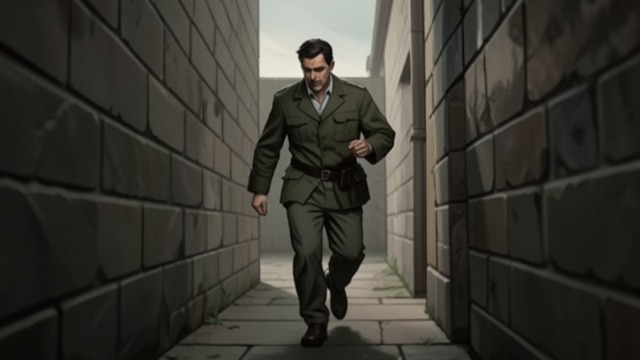
Steps Between Walls
A Route Measured
In the cell, he counts the steps between door and wall and tries to place each foot where it fell before. The small route becomes a substitute for the organized movements of scouting, but it has no destination beyond its own repetition.
Counting promises precision. He checks his stride, turns, and returns, treating variation as a possible mistake that must be corrected before it unsettles him further.
Control Narrowed
The routine reveals how far his field of action has contracted. The remembered compass once oriented him toward a wider world; now counting only confirms the boundaries of the room and the persistence of his confinement.
The Failed Bowline
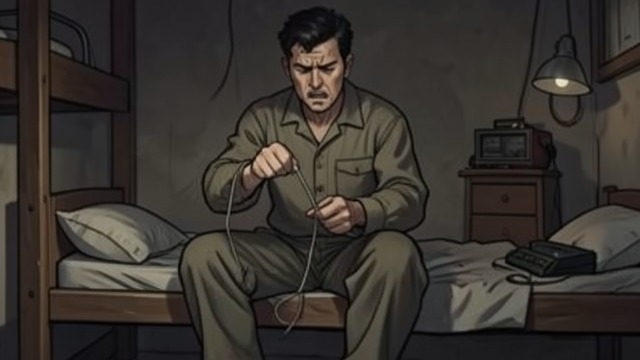
The String That Will Not Cooperate
Memory Cannot Guide the Hands
Much later, he sits on his bunk with a piece of string and tries to tie a bowline. He is certain that one approach is right, then another, but the knot still fails to take shape.
He shuts his eyes to recover the diagrams from the scout manual, yet the remembered pictures no longer make the physical task clear. The scene reverses his earlier confidence: the skill he once claimed to retain cannot now be reliably performed.
Frustration Replaces Mastery
Unable to tolerate the failure, he squeezes and throws away the string, then watches it as if concentrating might destroy it. The episode converts a modest practical difficulty into another encounter with the sense that ordinary attempts end in frustration.
The lost knot does not simply mark fading memory. It shows how confinement has stripped a once-useful competence of its context, leaving him with recollections of mastery but little ability to turn them into effective action.
early in the cell confinement, during a recollection of childhood
early in the night, shortly after the scout troop memory
during the same early-night recollection, after he recites the compass
later in confinement, during repeated pacing between the cell door and wall
late in the novel, after the officers’ commitment and during another period in the cell
